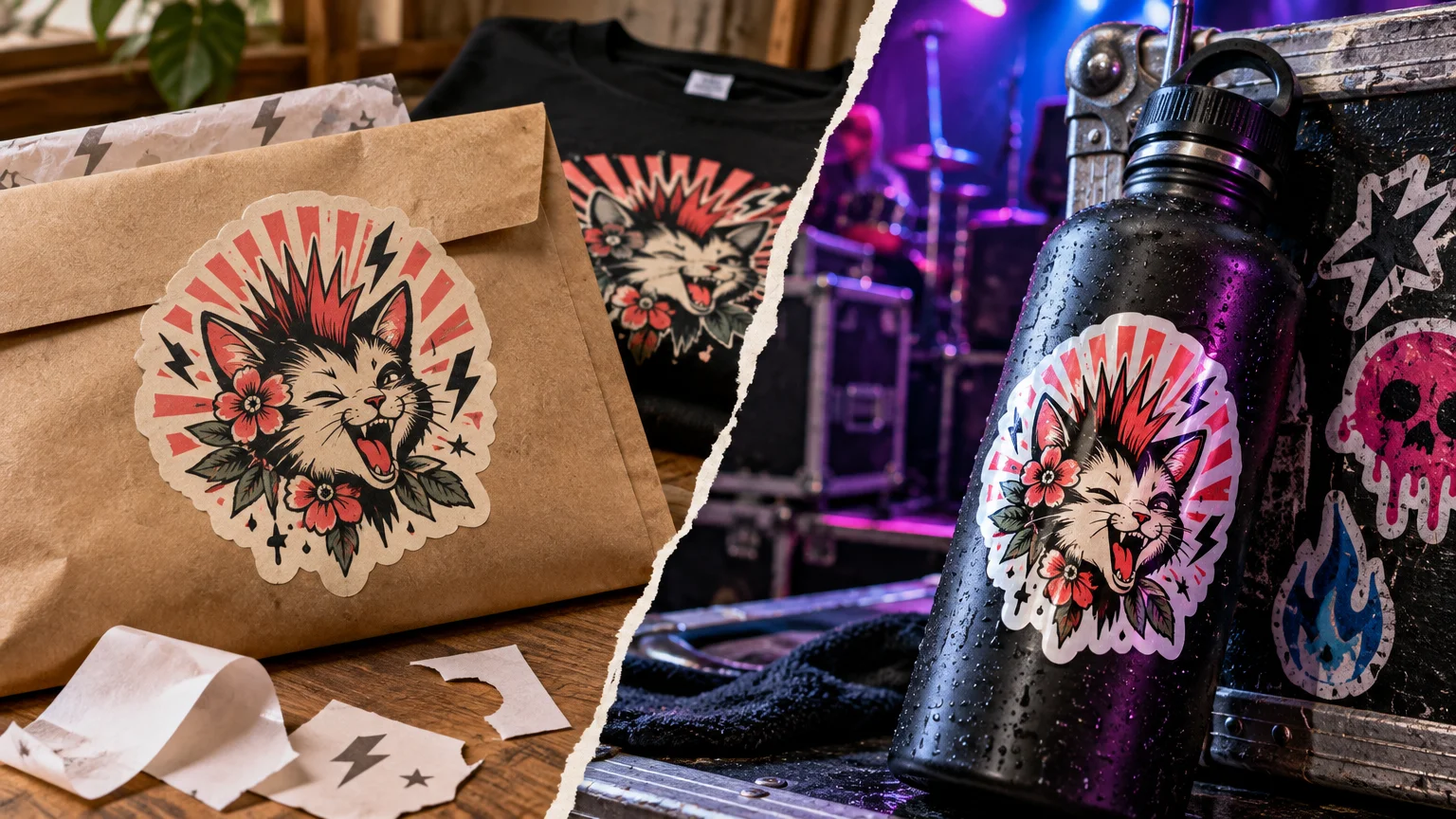
TLDR: Choose for the sticker’s next destination
For paper vs vinyl stickers merch packaging decisions, use paper when the sticker’s job ends on a dry box, tissue wrap, envelope, or indoor product package. Choose vinyl or another specified durable film when the sticker becomes merchandise, a giveaway, or promotion that might land on a bottle, laptop, road case, window, or piece of gear.
The useful answer is not simply “paper for cheap, vinyl for good.” A sticker is a combination of face material, adhesive, print, optional laminate, and release liner. Its performance also depends on the target surface and exposure. Paper can be the sharper creative choice for a tactile package seal, while a poorly specified film sticker can still fail on textured cardboard or difficult plastic.
Paper vs vinyl stickers for merch packaging starts with the job
First decide whether you are making part of the package or something the customer is expected to keep. Those are different products even when they use identical artwork.
A seal across the edge of a mailer has a controlled assignment: adhere to one known surface, survive packing and delivery, and contribute to the unboxing. A sticker tucked inside that mailer has an open-ended assignment. Its owner could put it on a notebook today and an equipment case six months from now.
Avery’s material guidance places paper labels in cost-conscious, dry packaging applications, while film and vinyl options generally provide greater resistance to moisture, oils, scuffing, tearing, and repeated handling. The correct choice still depends on the actual application.
| Use | Usually start with | Reason |
|---|---|---|
| Tissue-wrap or envelope seal | Paper | Controlled, dry use where texture and print character matter |
| Branded box or mailer closure | Paper or tested film | The package coating, texture, and removal experience decide |
| Merch-table giveaway | Specified durable film | The eventual surface and handling are unknown |
| Laptop, bottle, case, or gear sticker | Specified durable film, optionally laminated | Greater exposure to moisture, oils, rubbing, and travel |
| Window or glass promotion | Clear or opaque film with a suitable adhesive | Transparency, viewing direction, removal, and residue matter |
| Limited-edition collectible | Paper, clear, metallic, holographic, or film | The intended visual experience may matter more than maximum toughness |
When paper stickers are an intentional choice
Paper belongs on dry, controlled packaging when its surface character supports the project. Uncoated white paper can feel direct and print-like. Kraft or colored paper can suit earthy, handmade, archival, punk-flyer, or stripped-back packaging. A paper seal can also be easier to treat as part of a label system rather than a detachable piece of merch.
That base color participates in the artwork. Ink printed on kraft does not behave visually like ink printed on a bright white base. Pale colors may become subdued, and unprinted areas reveal brown rather than white. Small text and fine lines need enough contrast to remain legible.
Paper is less convincing when recipients are supposed to transfer the sticker onto an unknown object. Moisture, skin oils, edge picking, and abrasion can punish an unprotected paper face. Applying a laminate may improve appearance and add some protection, but it does not automatically turn every paper-and-adhesive construction into a waterproof, outdoor-rated sticker.
Use paper for the package because paper suits the package—not because the customer will necessarily treat the sticker gently.
When merch needs vinyl or another durable film
A band sticker handed out after a set may be folded into a pocket, stuck to a water bottle, or slapped onto a road case. An artist’s order insert might migrate to a laptop. Once the recipient controls the destination, a durable film is the safer starting point.
“Vinyl” is often used as a broad shopping term, not a guarantee of one chemistry or performance level. For example, Siser identifies polypropylene for some printable glossy and matte sticker media, while its transparent and holographic products use PET. That is one illustration of why the product specification matters more than the category nickname.
Do not assume every product sold as vinyl is waterproof, UV-resistant, removable, permanent, or outdoor-rated. Ask what the face film is, whether the print has a protective layer, what adhesive is used, and what exposure the finished construction is specified to handle. For a deeper material-focused comparison, see the guide to durable sticker and decal materials.
The adhesive can matter as much as the visible material
The face material gets the attention because it carries the art. The adhesive determines whether that art stays attached. UPM’s overview of pressure-sensitive label construction separates face materials, adhesives, and liners, with different combinations intended for different packaging materials and conditions.
That distinction matters when comparing a smooth coated box with recycled cardboard, glass, a curved bottle, or a low-energy plastic case. A film face does not rescue an adhesive that is wrong for the surface.
- Permanence: Is this a tamper-evident-style package closure, a decorative seal, or something the buyer should remove cleanly?
- Surface texture: Corrugated, recycled, powdery, or heavily textured packaging provides less uniform contact than smooth glass or coated board.
- Shape: Tight curves and small-diameter bottles can place lifting pressure on sticker edges.
- Cleanliness: Dust, condensation, oils, and handling residue interfere with contact.
- Temperature: Application in a cold loading area may behave differently from application in a controlled packing room.
- Exposure: Consider moisture, rubbing, oils, cleaning, sunlight, and repeated handling.
- Removal: If the sticker goes on reusable glass or a retail display, residue and clean removal may be part of the brief.
Test the actual package, not a nearby substitute. A proof attached to smooth sample board tells you little about adhesion to your textured recycled mailer.
What laminate adds—and what it does not
A laminate is a transparent protective layer placed over the printed face. Depending on the specified product, it can change sheen and improve resistance to scuffs, abrasion, chemicals, or weathering. 3M, for example, describes one particular overlaminate label material as providing protection against abrasion, scuffs, chemicals, and weathering. That is a construction-specific claim, not a promise applying to every laminate.
Siser likewise says its printable sticker products may be used alone or with adhesive lamination that adds matte, gloss, or holographic effects. A laminate therefore serves two roles: surface protection and visual finish.
It cannot fix every weak point. Water may still reach exposed paper edges. An unsuitable adhesive can still lift. The wrong ink and laminate combination can still have limitations. If wet or outdoor use matters, request a finished sticker construction specified for that use rather than assembling assumptions from separate material names.
Match matte, gloss, clear, and reflective effects to the artwork
Matte for controlled glare and a softer surface
Matte finishes reduce hard reflections, which can help small type and subdued artwork remain readable beneath direct merch-table or retail lighting. They can also reinforce a tactile, print-oriented package. Guerilla Stickers positions matte as the lower-glare direction and gloss as the more visually assertive option.
Matte is not automatically clearer in every situation. Low-contrast gray type can still disappear in a dark venue. Print a sample at final size and check it under the kind of light where it will actually be seen.
Gloss for punch, contrast, and reflected light
Gloss can make saturated artwork feel louder and can suit polished packaging or bright merch graphics. Its tradeoff is glare: a ceiling spotlight or camera flash may obscure small text at particular angles. If a sticker contains a URL, handle, or tiny release date, test readability while tilting the sample rather than viewing it flat under studio lighting.
Clear stock makes the application surface part of the design
Clear stickers work naturally on windows, glass, and clean surfaces, but transparent material does not provide the white background that conventional full-color artwork expects. StickerApp’s guidance explains that white ink can create opacity while selected areas can remain transparent.
Without a white underbase, colors may become translucent or change against dark, colored, or reflective objects. A black guitar case, amber bottle, and clear window will produce three different visual results from the same ink layers. Confirm which areas receive white ink, which remain clear, and whether the sticker is viewed from the adhesive side or face side.
Metallic and holographic stock can hijack brand color
Metallic and holographic materials are excellent when the changing surface is part of the concept: a tour-exclusive sticker, record-release bundle, festival badge, or numbered art drop. They are less predictable when exact flat color reproduction is the priority. StickerApp notes that holographic and metallic materials affect how colors appear.
Leave some areas unprinted or selectively transparent if you want the effect to show through. Use opaque white strategically when parts of the art need stable color. Keep critical text bold enough to survive reflections and movement. Under venue lighting, a holographic field may look explosive from one angle and relatively dark from another.
Do not send one unchanged file for white, kraft, clear, and holographic stock and expect identical results. Each base changes contrast, opacity, negative space, or color. Approve a material-specific proof before committing to a run.
Four practical merch and packaging choices
- Apparel mailer seal: Start with paper if the mailer stays dry and the sticker is intended to be broken or discarded during opening. Test adhesion on the exact mailer coating and decide whether tearing, clean removal, or visible tampering is the desired behavior.
- Merch-table giveaway: Start with a specified durable film because the recipient chooses the destination. Favor a readable shape, clean edge, and artwork that still works on common light and dark surfaces.
- Glass or window promotion: Consider clear film when the glass should remain visible, but plan white ink and viewing direction deliberately. Verify whether clean removal is required before selecting the adhesive.
- Limited-edition release bundle: Let the concept drive the material. Kraft can support a handmade cassette or zine package; holographic can give a synth, metal, pop, or electronic release a changing visual hit. If the sticker is also meant to travel onto gear, pair the effect with an appropriately durable construction.
Stickers can also connect an unboxing moment to a wider launch or referral plan. These small-brand sticker campaign ideas show how packaging, inserts, and giveaways can play different roles instead of repeating the same message.
A pre-order checklist that prevents expensive surprises
Before reviewing custom sticker printing options, write a one-sentence job description: “This sticker seals a coated apparel mailer indoors,” or “This is a giveaway expected to land on bottles, laptops, and cases.” Then confirm the complete construction rather than choosing from the material name alone.
- Identify the exact target surface—or admit that the recipient will choose an unknown surface.
- Define dry indoor, refrigerated, frequently handled, wet, or outdoor exposure.
- Ask for the face material, adhesive behavior, and any laminate or protective layer.
- Decide whether permanent grip, repositionability, or clean removal matters.
- Check final-size text, line weight, borders, and the cut path.
- Specify white ink or an underbase for clear, metallic, or holographic work where needed.
- View matte and gloss samples beneath realistic retail, venue, and daylight conditions.
- Test a representative physical sample on the actual package or object.
- Approve a proof that names the material and finish, not only the artwork.
- Keep required product information and regulated labeling separate from decorative merch decisions unless the construction is specifically qualified for that purpose.
The final call
Choose paper when the sticker belongs to a known, dry package and paper’s texture or base color improves the presentation. Choose vinyl or another specified durable film when the sticker is merch in its own right and must survive unknown surfaces, handling, moisture, and travel.
Then verify the less glamorous details: adhesive, protective layer, opacity, application surface, and lighting. The best material is the simplest tested construction that delivers the intended look and survives the sticker’s real job. Order or request a representative sample, apply it to the actual surface, and let that result decide the full run.

