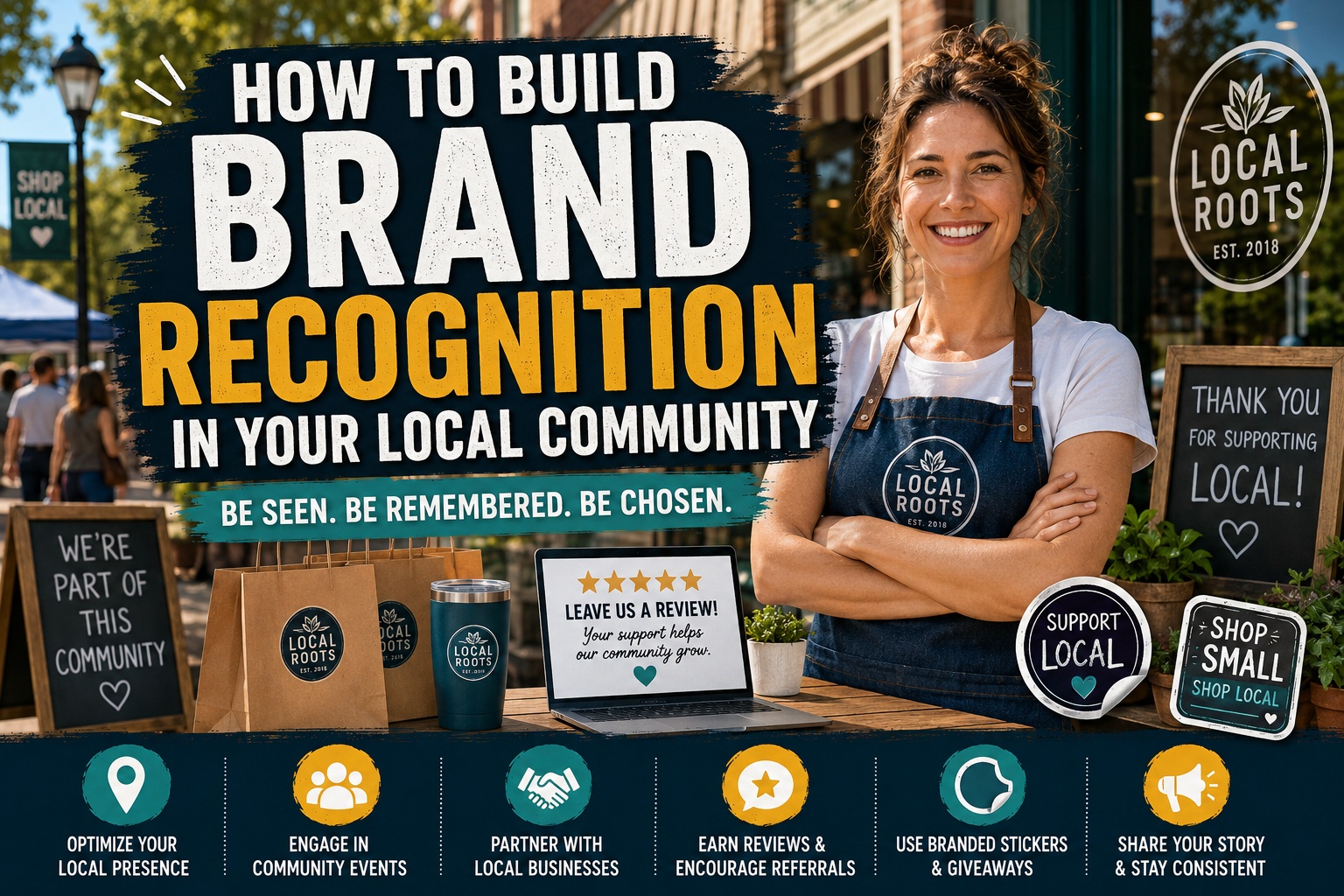
TLDR
Building local brand recognition comes down to repeated, consistent exposure.
- Use the same name, logo, colors, and message everywhere.
- Keep your Google Business Profile accurate and active.
- Show up regularly at markets, events, and community organizations.
- Partner with businesses that serve similar customers.
- Ask satisfied customers for reviews and referrals.
- Give people useful branded items they will keep.
- Track recognition, not just immediate sales.
You do not need everyone in town to recognize your business. You need the right people to remember it when they need what you sell.
A local customer may see your logo on a package, pass your booth at a neighborhood event, notice your name in a community group, and hear a friend recommend you. Any one of those moments might be forgettable. Together, they build familiarity.
That is how local brand recognition usually grows. It is less about one large campaign and more about showing up in recognizable ways, in the right places, over time.
Start With a Brand People Can Recognize
Before you work on local visibility, make sure your business looks and sounds consistent.
Your brand identity should include:
- A business name used the same way everywhere
- A readable logo
- A small set of brand colors
- One or two primary typefaces
- A clear description of what you offer
- A consistent tone of voice
- A recognizable visual style
The goal is not to make every social post, sign, package, and flyer look identical. The goal is to make them feel as if they came from the same business.
Suppose a bakery uses a dark green logo on its storefront, a pink logo on its website, and an older brown logo at farmers markets. Customers may not connect those appearances. Consistency helps each impression strengthen the previous one.
It also helps to describe the business in plain language.
A vague message might say:
Quality service with a personal touch.
A more useful message might say:
Custom cakes and decorated cookies for birthdays, weddings, and local business events.
The second version gives people something specific to remember.
Decide What You Want to Be Known For
Brand recognition is not only about recognizing a logo. People should also connect your business with a particular product, service, quality, or experience.
Ask yourself:
What should someone say when recommending us?
Possible answers include:
- “They make the custom cookies.”
- “They are the shop with the funny local stickers.”
- “They can usually repair it the same week.”
- “They are great with first-time homebuyers.”
- “They make really durable workwear.”
- “They are the florist near the courthouse.”
Trying to be known for ten things at once usually weakens the message. Choose one primary association, then support it with two or three secondary qualities.
For example:
Primary association: Custom wedding flowers
Supporting qualities: Local, dependable, easy to work with
This gives your marketing a clear direction. Your photos, partnerships, events, signs, content, and printed materials can all reinforce the same idea.
Make Local Search Part of Your Brand Presence
Local brand recognition happens online as well as in person.
A customer may hear your business name in conversation and search for it later. Make sure the information they find confirms that they have the right company.
Your Google Business Profile should include:
- Correct business name
- Current address or service area
- Phone number
- Website
- Business hours
- Primary business category
- Product or service information
- Recent photos
- Appointment, menu, or ordering links
- Answers to common questions
Google states that complete and accurate business information helps customers understand what a company offers and can improve its ability to appear in relevant local searches.
Use the same basic business name, contact information, and description on your website, social accounts, directories, and community listings. Small inconsistencies may not seem important, but they create uncertainty for customers.
Photos are especially useful for local businesses. Show the building, team, products, service vehicles, booth setup, completed work, and recognizable landmarks near the location.
Generic stock photography may look polished, but it does little to prove that you are part of the local community.
Show Up in the Same Places Repeatedly
One event may create a few sales. Regular attendance creates recognition.
Consider places where your target customers already spend time:
- Farmers markets
- Craft fairs
- School events
- Chamber of commerce meetings
- Neighborhood festivals
- Youth sports
- Local fundraisers
- Business networking groups
- Trade associations
- Community classes
- Pop-up markets
- Holiday events
The U.S. Small Business Administration recommends local listings, professional groups, event participation, community sponsorships, and relationships with complementary businesses as practical local marketing strategies.
You do not need to participate in every event. Choose a few that fit your customers and return consistently.
A pet-grooming company may gain more from a recurring shelter event than from a general business expo. A wedding photographer may be better served by bridal events and partnerships with local venues.
Repeated exposure matters. People may walk past your booth several times before they stop. And they may meet you at one event, then finally make a purchase after seeing you again somewhere else.
Make Your Booth or Display Easy to Recognize
A local event booth should not look like an unrelated collection of tables, bins, and signs.
Use the same visual elements each time:
- Branded tablecloth
- Clear banner
- Consistent product signs
- Matching price cards
- Staff clothing or name tags
- Branded bags or boxes
- Business cards
- Stickers or small giveaways
Your business name should be readable from outside the booth. A visitor should also be able to tell what you sell without asking.
Avoid covering every available surface with text. One clear business name and one clear product description will usually do more than twelve small signs competing for attention.
Take photos of your setup and review them later. The booth may look organized from behind the table but cluttered from the customer’s side.
Build Partnerships With Other Local Businesses
Partnerships help two businesses share attention without paying to reach entirely separate audiences.
Look for businesses that serve similar customers but are not direct competitors.
Examples include:
- Florist and wedding photographer
- Realtor and home inspector
- Gym and meal-prep company
- Bakery and coffee shop
- Pet groomer and dog trainer
- Artist and frame shop
- Boutique and jewelry maker
- Landscaper and garden center
- Caterer and event venue
- Brewery and food truck
A local partnership could involve:
- A shared giveaway
- A bundled product
- Referral cards
- An event
- A social media feature
- Samples placed in customer orders
- A seasonal promotion
- A shared workshop
- A display inside the other business
- A co-branded sticker or package insert
Start with something small and easy to measure.
For example, a coffee shop might include a bakery’s cards near the register while the bakery promotes the coffee shop on its order pickup table. If customers respond, the businesses can plan a larger collaboration later.
Do not approach another owner with a vague request to “cross-promote.” Bring a clear idea that benefits both sides.
Use Branded Stickers Beyond the Checkout Counter
Custom stickers can help local customers see your logo outside the original transaction.
The strongest promotional stickers are usually designs people want to use, not advertisements they feel obligated to accept.
Possible sticker concepts include:
- A local landmark
- A neighborhood name
- A business mascot
- A regional joke
- A simple illustrated product
- A seasonal design
- A short phrase customers already associate with you
- A “support local” design
- A limited-edition event sticker
You can use custom vinyl stickers as:
- Package freebies
- Shopping bag seals
- Event handouts
- Loyalty rewards
- Product inserts
- Water bottle stickers
- Window giveaways
- Thank-you items
- Limited-edition merchandise
CustomStickers.com prints its vinyl stickers on waterproof material with a UV-resistant laminate intended for indoor and outdoor use.
The sticker should include enough branding to connect it to the business, but it does not always need a large website address and phone number. A well-designed mascot or local illustration may travel farther than a small adhesive business card.
For more direct contact information, business card stickers can combine a traditional card layout with an adhesive format. These can work well for service vehicles, order packets, event handouts, and product care materials.
Always get permission before placing promotional stickers on public property, other businesses’ displays, utility poles, street signs, or private surfaces. Giving stickers to customers is useful marketing. Creating cleanup work for the city is less helpful.
Put Your Branding on Products and Packaging
Customers should be able to identify where a product came from after they leave the store or event.
Add branding to:
- Shopping bags
- Shipping boxes
- Bakery boxes
- Cups
- Product labels
- Tissue paper
- Thank-you cards
- Care instructions
- Receipts
- Package seals
- Reusable containers
- Delivery vehicles
You do not need fully custom packaging to create a consistent presentation. A plain kraft bag with a clean logo sticker can be enough.
Include the information customers are most likely to need later:
- Business name
- Website
- Social handle
- Reordering information
- Care instructions
- Product name
- Contact information
Good packaging helps the customer remember the business without turning every surface into a billboard.
Ask Customers for Reviews at the Right Time
Reviews connect local word of mouth with local search.
Google notes that reviews appear beside Business Profiles in Search and Maps, giving potential customers information about the business.
Ask shortly after a positive experience:
Thanks for choosing us. If you have a moment, would you mind leaving an honest review? It helps local customers find our business.
Make it easy by providing a direct review link or a tested QR code.
Avoid asking only for “five-star reviews.” Ask for honest feedback. The goal is to build trust, not create a suspicious wall of identical praise.
Respond to reviews calmly and specifically. Thank customers for positive comments. When a customer raises a real problem, acknowledge it and explain how they can contact you.
Your responses are not only for the person who wrote the review. Future customers will read them too.
Encourage Word-of-Mouth Referrals
People frequently ask friends, neighbors, coworkers, and local groups for recommendations.
Make your business easier to refer by giving customers a simple description they can repeat.
Compare:
They do all kinds of creative work and marketing things.
With:
They print custom stickers and labels for local businesses.
The second description is clearer and easier to pass along.
A referral reminder can be direct without being awkward:
Most of our new customers hear about us from someone local. Feel free to share our information with anyone who could use our services.
You could also create a referral program with:
- Store credit
- A small free product
- A future discount
- A service upgrade
- A reward for both customers
- A quarterly drawing
Keep the rules simple. A referral program should not require customers to study terms and conditions before mentioning your name to a neighbor.
Create Content About the Community
Local content gives people a reason to follow your business even when they are not ready to buy.
Possible topics include:
- Local event guides
- Seasonal reminders
- Community spotlights
- Local customer stories
- Neighborhood history
- Behind-the-scenes event setup
- Partnerships with nearby businesses
- Volunteer projects
- Local gift guides
- Weather-related product advice
- Regional tips connected to your service
A garden center might publish planting advice for the local climate. A mechanic could explain how regional winter conditions affect vehicle batteries. A bakery might share a guide to ordering treats for nearby school events.
This content reinforces two things at once: what the business knows and where it belongs.
Avoid forcing a local angle into every post. The connection should be useful, not a repeated sentence about being “proudly local.”
Support Community Causes Thoughtfully
Sponsorships and donations can build recognition, but they work best when the connection is genuine.
Options include:
- Youth sports sponsorships
- School auctions
- Charity events
- Food drives
- Animal shelters
- Local arts organizations
- Community cleanups
- Scholarship programs
- Holiday donation campaigns
- Volunteer days
Choose causes that fit the business, customers, or team.
A pet business may naturally support an animal shelter. A bookstore may work with school literacy programs. A construction company may contribute to a housing repair project.
Do not make the donation entirely about your logo. It is reasonable to be recognized as a sponsor, but the support should still be useful if the promotional benefit is smaller than expected.
Create Small Traditions People Remember
Local brands often become recognizable through recurring habits.
You might create:
- A monthly featured product
- An annual community giveaway
- A seasonal sticker
- A recurring workshop
- A customer appreciation day
- A holiday display
- A yearly fundraiser
- A weekly local-business feature
- A recognizable booth activity
Consistency turns a promotion into a tradition.
A coffee shop that releases a new local artist sticker every month gives customers something to anticipate. A landscaper that publishes the same spring yard checklist each year becomes associated with seasonal preparation.
Not every tradition needs to be large. It only needs to be recognizable and repeatable.
Keep the Customer Experience Consistent
Brand recognition can bring someone through the door. The experience determines what they remember afterward.
Pay attention to:
- Response time
- Staff communication
- Cleanliness
- Packaging
- Follow-up
- Problem resolution
- Product quality
- Appointment reminders
- Delivery expectations
- Return or reprint handling
A polished logo cannot compensate for unclear pricing or unanswered messages.
The customer experience should reinforce the same qualities your branding promises. If the brand presents itself as simple and dependable, the ordering process should not require six emails to confirm basic details.
Consistency builds trust. And trust makes the business easier to recommend.
Track Local Brand Recognition
Brand recognition is harder to measure than direct sales, but it is not invisible.
Look for signs such as:
| Signal | What It May Indicate |
|---|---|
| More branded searches | People remember the business name |
| Direct website visits | Customers know where they want to go |
| Repeat event visitors | The booth or brand is becoming familiar |
| More reviews | Customers feel connected enough to respond |
| Referral mentions | Word of mouth is increasing |
| Sticker or QR scans | Printed materials are producing engagement |
| Social tags from local customers | People identify publicly with the brand |
| Partnership inquiries | Other organizations recognize the business |
| “I see you everywhere” comments | Repeated local exposure is working |
Ask new customers how they heard about you. Add simple source categories to your checkout, inquiry form, or customer notes.
Review the results every few months. You may find that one recurring market produces more recognition than several paid ads, or that a partnership creates more referrals than a social platform.
Common Local Branding Mistakes
Changing the Visual Style Too Often
A refresh can help an outdated brand. Constant redesigns make recognition harder.
Joining Every Event
More appearances do not automatically create better recognition. Choose events that reach the right people.
Making Every Interaction Promotional
Community participation should include listening, helping, and building relationships. Not every conversation needs a coupon.
Using Inconsistent Business Information
Different hours, phone numbers, logos, and business names create confusion.
Focusing Only on New Customers
Existing customers are often the source of repeat purchases, reviews, referrals, and visible product use.
Choosing Giveaways No One Wants
A useful or appealing item keeps the brand visible. A disposable piece of clutter does not.
Expecting Immediate Results
Local recognition develops through repeated exposure. One booth, one sponsorship, or one batch of stickers is a start, not the whole strategy.
A Simple 90-Day Local Brand Recognition Plan
Month One: Make the Brand Consistent
- Confirm your logo, colors, and primary message.
- Update your website and business listings.
- Replace outdated signs and profile images.
- Create a simple review request.
- Decide what you want the business to be known for.
Month Two: Increase Local Visibility
- Attend one relevant community event.
- Contact two complementary businesses.
- Publish two pieces of local content.
- Add branded packaging or stickers to customer orders.
- Take new photos for your business profiles.
Month Three: Build Repetition
- Return to the strongest event or community group.
- Launch one small partnership.
- Ask customers how they found you.
- Review searches, referrals, QR scans, and event results.
- Choose one activity to repeat monthly or seasonally.
At the end of 90 days, keep the activities that produced recognition, conversations, inquiries, or repeat customers. Remove the ones that only kept you busy.
Frequently Asked Questions
How Long Does It Take to Build Local Brand Recognition?
Most businesses should expect gradual progress rather than immediate recognition. The timeline depends on market size, competition, customer frequency, event participation, and how consistently the brand appears.
What Is the Cheapest Way to Build Local Brand Awareness?
Start with accurate business listings, reviews, referrals, partnerships, local content, and consistent branding. These require time but can be started with little advertising expense.
Do Stickers Help People Remember a Business?
They can. Stickers work best when the design is appealing enough to keep and clearly connected to the brand. They can extend visibility onto packages, bottles, laptops, notebooks, vehicles, and other personal items.
Should a Local Business Sponsor Events?
Sponsorship can be useful when the event reaches relevant customers and the business can participate consistently. A smaller recurring event may produce more recognition than a large one-time sponsorship.
How Important Are Customer Reviews for Local Branding?
Reviews help customers evaluate a local business after hearing its name or finding it in search results. They also provide visible evidence of previous customer experiences.
Can a Service Business Build Local Recognition Without a Storefront?
Yes. Service businesses can use branded vehicles, uniforms, yard signs, reviews, partnerships, community groups, local content, and event participation to create visibility without a retail location.
Final Thoughts
Building brand recognition in your local community is mostly about consistency.
Use the same visual identity. Explain the business clearly. Show up where your customers already spend time. Build partnerships, support useful causes, ask for reviews, and give people something worth remembering.
You do not need to become the most recognized business in the entire city. You need to become a familiar and trusted choice for the customers you can actually serve.
And when someone says, “I keep seeing your business everywhere,” that usually means the small efforts are starting to add up. Consistent branding, community participation, partnerships, reviews, and printed materials reinforce one another, so the business becomes easier to recognize and recommend.